
1. Municipality Profile
Key Economic Sectors
One of Riga’s priorities is to be a competitive city with an innovative economy. The target is to develop Riga as a nationally and internationally oriented science, education, and innovation center, creating a supportive environment for the development of innovations. Make better use of the economic potential of the city by ensuring excellent integration into national and international mobility networks, developing cooperation within RMA, making more efficient use of degraded areas, improving the image of the city and fostering attraction of investment, talent, and tourists. Achieve an equalisation of GDP per capita compared to metropolises in neighboring countries. Major industries: Tourism, logistics, and export (Riga is a Port city), and the ICT sector.
The economy of Riga is an important part of the economy of Latvia. This is because of the size of Riga’s GDP, the number of workers, companies, amounts of investment, and other indicators:
- 341 600 or 34,8 % of all economically active residents of Latvia live in Riga;
- A total of 480 100 people are employed in Riga, which is 46 % of all people employed in Latvia;
- 60 % of economically active companies are in Riga and its suburbs;
- 57 % of investments are made in Riga;
- In 2018, Riga’s GDP was EUR 16,395 billion (EUR 25 820 per capita), or 56 % of Latvia’s total GDP;
- sectors with the greatest added value include retail (16 %), real estate transactions, (11 %) and transport and storage (10 %).
Governance Structure
The city council is elected in equal, direct and proportional elections by secret ballot for a 4-year term. The Riga City Council (RCC) consists of 60 councillors. The City Council shall elect from among its members the Chairperson of the Council, the Vice-Chairpersons of the Council and the members of the Standing Committees. In order to ensure its activities and prepare matters for consideration at the meetings of the Council, the Dome shall establish permanent committees, the personal composition of which shall be determined by taking a separate decision of the Council.
The Council has the following committees: The Committee on Financial and Administration Affairs; The Committee on Social Affairs; The Urban Development Committee; The Environment Committee; The City property and Privatisation Affairs Committee; The Committee on Education, Youth Affairs and Sport; The Committee on Culture, Art and religious Affairs; The Committee on oral and residential matters; The Committee on Transport and Transport; the Committee on Security and order matters.
2. Motivation for Climate Neutrality
Reasons for Action
In 2008 the Riga City Municipality joined the initiative of the European Covenant of Mayors. Also, Riga joined to Paris Climate Declaration “Cities Leading the Way to Climate Neutrality” and Riga also is EU Mission “100 Climate-Neutral and Smart Cities by 2030” and submitted Riga City Climate Contract in September of 2024.
Riga faces many problems, which force the City to take action, for example, energy poverty, floods, heat islands in summer etc.
Strategic Goals
Within the Riga Climate City Contract Riga set new goals. The new target for the achievement of the 2030 climate goals of the RSCM Action Plan (‘action plan’) is a 53 % CO2 emissions reduction compared to 2019, which at the same time means a CO2 emissions reduction of 80 % compared to 1990, reaching climate neutrality in municipal infrastructure. Forest areas are additionally planned to be used to provide a constant sequestration of CO2 of around 300 ktCO2 per year by 2030. This provides a 16 % reduction in CO2 emissions compared to the total emissions in 2019.
3. Baseline Assessment
Data Collection Process
A lot of data for municipal buildings have been taken from Riga’s energy management system, and other data, about transport, residential buildings have been collected through collaboration with municipal departments annually.
CO2 Emission Inventory
The primary sources of greenhouse gas emissions in Rīga Municipality, based on the 2021 CommitClimate baseline inventory, include:
- Transport (31.7%)
- Waste management (23.9%)
- Residential and municipal buildings (21.9%)
- Industry and construction (13.9%)
- Other economic activities, excluding industry and commercial and tertiary activities (5.7%)
- Commercial and tertiary sector (2.6%)
- Public infrastructure (0.4%)
Total Emissions:
Total annual greenhouse gas emissions in the baseline year (2021) are estimated at approximately 2,105,664 tonnes CO₂eq.
Total Energy Consumption:
Total annual final energy consumption in Rīga Municipality in the baseline year is approximately 10,530 GWh.
4. Measures and Planning
Focus Areas
The modelling results indicate that residential buildings and private transport offer the largest energy-saving and CO₂ emission-reduction potential among the tested policy measures. Large-scale renovation of multi-family residential buildings is the most effective individual intervention, followed by reductions in private passenger transport demand.
Transport represents the largest share of emissions in the baseline inventory, while waste management is also a major contributor. However, no additional waste management policies were tested in the current simulation. Industrial and commercial activities also account for substantial energy consumption and emissions, indicating further opportunities for mitigation.
Rīga benefits from an established municipal energy and climate planning framework, including the Sustainable Energy and Climate Action Plan until 2030 (SECAP2030), municipal energy management practices and access to sectoral data. The CommitClimate simulator complements these efforts by enabling quantitative comparison of selected policy measures and long-term development scenarios.
Important barriers include the scale of investment required for building renovation, the complexity of changing private travel behaviour, existing infrastructure constraints and the limited coverage of several emission-intensive sectors in the current policy scenario.
Priority indicators include:
- Renovation rate of residential buildings.
- Passenger kilometers by transport mode.
- Share of LED lighting in public infrastructure.
- Share of electric vehicles in the municipal fleet.
- Waste generated per capita.
CommitClimate supports scenario modeling and cross-sector alignment of emission reduction strategies, strengthening Riga’s ability to reach climate neutrality by 2050.
Key Measures Implemented
Riga is taking a multi-sectoral approach to emissions reduction. Measures include:
- Renovation programs for multi-family residential buildings.
- LED upgrades in public lighting.
- Gradual electrification of the municipal vehicle fleet.
- Promotion of compact urban planning to reduce private transport demand.
The CommitClimate project supports Riga in modeling various decarbonization scenarios, providing clarity on cost-effectiveness and emissions reduction potential of different policy mixes. It also enhances interdepartmental coordination.
Scenario Simulation Results
The simulations were conducted for exploratory and analytical purposes. They do not represent official projections, nor have they been formally adopted or endorsed by Rīga Municipality.
Residential Buildings:
- Policy: Large-scale renovation of multi-family residential buildings (30% annual implementation rate, 40% expected energy savings), starting in 2025.
- Results by 2050:
- Annual energy savings: 848,730 MWh (27.3%)
- Annual CO₂ reduction: 123,068 tonnes (29.2%)
Municipal Buildings:
- No additional policy measures were tested for municipal buildings in the current simulation. Consequently, the policy scenario remains identical to the baseline scenario, with no additional energy savings or CO₂ emission reductions attributed to this sector.
Public Infrastructure:
- Policy: Replacement of inefficient light bulbs in public lighting (5% annual implementation rate), starting in 2025.
- Results by 2050:
- Annual energy savings: 15,006 MWh (18.3%)
- Annual CO₂ reduction: 1,636 tonnes (18.3%)
Other Sectors:
- No additional policy measures were tested in the commercial and tertiary, industry and construction, agriculture and forestry, or other economic sectors. Energy consumption and emissions therefore remain identical in the baseline and policy scenarios.
Transport Sector:
- Municipal Fleet: Electrification of municipal passenger cars, with a target of 100% electric vehicles in the relevant passenger-car category, implemented from 2025 to 2050.
- Results by 2050:
- Annual energy savings: 1,777 MWh (13.2%)
- Annual CO₂ reduction: 623 tonnes (19.3%)
- Public Transport: No dedicated public transport policy measures were introduced. However, the general passenger travel-frequency reduction measure affects public transport demand indirectly.
- Indirect results by 2050:
- Annual energy savings: 25,305 MWh (11.8%)
- Annual CO₂ reduction: 5,350 tonnes (11.8%)
- Private Transport: Reduction in passenger transport demand through shorter daily travel distances and reduced travel frequency (2% annual implementation rates), starting in 2025.
- Results by 2050:
- Annual energy savings: 254,969 MWh (8.3%)
- Annual CO₂ reduction: 61,090 tonnes (8.9%)
Waste Management:
- No additional waste management policies were tested in the current simulation. Consequently, the baseline and policy scenarios remain identical, with no additional policy-driven reduction in waste generation or greenhouse gas emissions.
Local Energy Production:
- No additional policies specifically targeting local electricity production, district heating generation, renewable energy deployment or energy imports and exports were tested.
- The model represents electricity and district heating supply requirements, including distribution losses. Energy supply requirements decrease as a result of energy-saving measures implemented in other sectors, particularly residential buildings.
- These changes should not be interpreted as additional independent savings from local energy production policies.
Overall Simulation Results
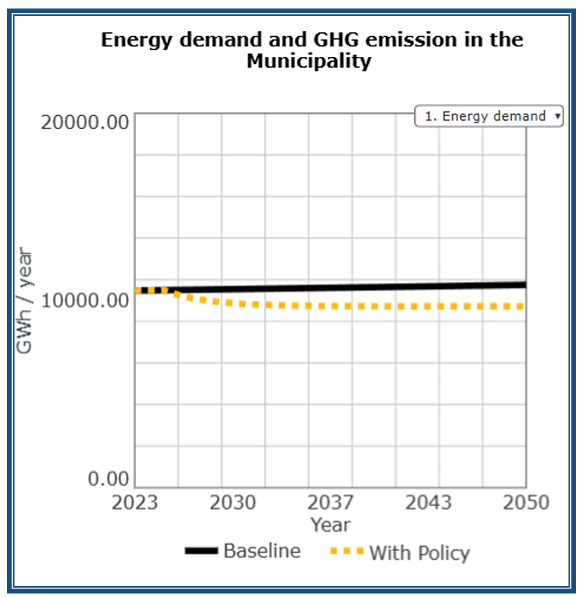
The simulation results show that total energy demand in Rīga Municipality gradually increases in the baseline scenario due to assumed population growth of approximately 0.5% per year and changes in activity levels. By 2050, total energy demand reaches approximately 10,836.2 GWh/year in the baseline scenario.
The implementation of the selected policy package leads to a reduction in energy demand, with the strongest initial effects occurring after the introduction of the measures in 2025. Energy demand subsequently stabilises and reaches approximately 9,690.4 GWh/year by 2050.
This corresponds to annual energy savings of approximately 1,145,787 MWh, or 10.6%, compared with the 2050 baseline projection.
The largest contribution to energy savings comes from the renovation of multi-family residential buildings, which reduces annual energy demand by approximately 848,730 MWh. Private passenger transport demand reduction provides the second-largest direct contribution, with annual savings of approximately 254,969 MWh.
Further savings are achieved through public lighting improvements, municipal passenger car electrification and the indirect reduction in public transport demand associated with lower passenger travel frequency.
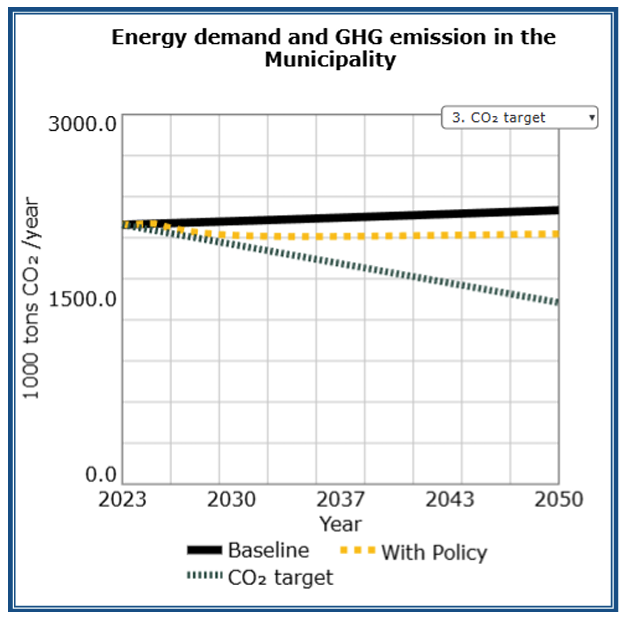
The selected policy package also reduces greenhouse gas emissions. By 2050, total annual CO₂ emissions reach approximately 2,223,500 tonnes in the baseline scenario, compared with approximately 2,031,700 tonnes in the policy scenario.
This corresponds to annual CO₂ emission savings of approximately 191,765 tonnes, or 8.6%, compared with the 2050 baseline projection.
Residential building renovation provides the greatest direct contribution to emission reductions, achieving approximately 123,068 tonnes CO₂/year in savings. Private transport demand reduction contributes a further 61,090 tonnes CO₂/year. Public lighting improvements, municipal fleet electrification and indirect changes in public transport demand provide smaller additional reductions.
Although the tested measures produce measurable energy savings and emission reductions, the policy scenario remains above the model’s illustrative long-term CO₂ reduction target trajectory. The tested package achieves an 8.6% reduction compared with the 2050 baseline, while the illustrative target trajectory represents a substantially more ambitious reduction of approximately 30%.
Additional measures would therefore be required to achieve deeper long-term decarbonisation. Potential priorities include energy efficiency improvements in municipal buildings, dedicated public transport decarbonisation measures, stronger mitigation action in industrial and commercial sectors, waste prevention and treatment improvements, and decarbonisation of electricity and district heating supply.
The results provide an analytical basis for identifying further investment priorities, comparing policy options and supporting the future monitoring and review of Rīga’s SECAP2030 framework. They should be interpreted as scenario-based estimates rather than official municipal projections or formal assessments of SECAP2030 target achievement.
5. First steps implemented
Pre-Feasibility study description
Riga Energy Agency has identified young citizens as one of potential test groups for the Carbon Footprint Calculator and transfer of knowledge gained via testing the simulation tool. An activity “Energy Detective” was developed as an attractive service for the Riga City schools where REA experts provide easy-to-use information about energy consumption data, carbon footprint and steps to be taken by school administration, pupils and their families to reduce the footprint and to use energy in a more efficient way. REA has organized a simple registration tool for the teachers of schools to apply for the “service”. Activity is ongoing until the end of school year – June 2025.
One of the first tasks was to identify Latvian cities that would be interested in using the tool. As the main criteria was raised that cities are in a management phase where their SECAP are developed or renewed. In order to identify the city project team co-operates with the Ministry of Climate and Energy Latvian Association of Local and Regional Governments as well as the Latvian Association of local Governments.
6. Stakeholder Engagement
In October 2024 Riga Municipality together with RTU and REA initiated Riga School Climate Days competition: until April 2025 teams of school kids are engaged in energy saving activities, climate change actions and circular economy promotion in their schools. REA provides information about energy consumption of the particular school and teams are motivated to ensure more efficient usage of water, electricity and heat. Teams are encouraged using Carbon Footprint Calculator developed within the Project. REA provides an expert service to the involved schools – “Energy Detective” that explains basic principles of sustainable energy use. Tools developed and knowledge gained by REA experts within the Project is transferred to young citizens of Riga city. Promotion campaign of the Riga School Climate Days inter alia aims at attracting citizens attention to the sustainable energy use. It is believed that school kids will share the information and suggestions to their families thus multiplying the engagement.
Till 31 December 2024 the REA “Energy Detective” has visited five (5) schools, engaging with approx 180 young citizens and their teachers.
On 13 December 2024 REA organized Riga School Climate Days on-line public discussion with RTU and other experts promoting “Energy Detective” services and inviting citizens to pay attention to the sustainable energy saving initiatives and tools. The recorded discussion is available on Riga City communication channels for all citizens.
Citizen engagement activity is ongoing.Potentially interested cities have been approached to agree on the most appropriate form of action for learning tools. The main step now is to prepare a description of the offer for cities to participate in, as well as a format for organising cooperation. This communication is ongoing.


