

1. Municipality Profile
Key Economic Sectors
One of Riga’s priorities is to be a competitive city with an innovative economy. The target is to develop Riga as a nationally and internationally oriented science, education, and innovation center, creating a supportive environment for the development of innovations. Make better use of the economic potential of the city by ensuring excellent integration into national and international mobility networks, developing cooperation within RMA, making more efficient use of degraded areas, improving the image of the city and fostering attraction of investment, talent, and tourists. Achieve an equalisation of GDP per capita compared to metropolises in neighboring countries. Major industries: Tourism, logistics, and export (Riga is a Port city), and the ICT sector.
The economy of Riga is an important part of the economy of Latvia. This is because of the size of Riga’s GDP, the number of workers, companies, amounts of investment, and other indicators:
- 341 600 or 34,8 % of all economically active residents of Latvia live in Riga;
- A total of 480 100 people are employed in Riga, which is 46 % of all people employed in Latvia;
- 60 % of economically active companies are in Riga and its suburbs;
- 57 % of investments are made in Riga;
- In 2018, Riga’s GDP was EUR 16,395 billion (EUR 25 820 per capita), or 56 % of Latvia’s total GDP;
- sectors with the greatest added value include retail (16 %), real estate transactions, (11 %) and transport and storage (10 %).
Governance Structure
The city council is elected in equal, direct and proportional elections by secret ballot for a 4-year term. The Riga City Council (RCC) consists of 60 councillors. The City Council shall elect from among its members the Chairperson of the Council, the Vice-Chairpersons of the Council and the members of the Standing Committees. In order to ensure its activities and prepare matters for consideration at the meetings of the Council, the Dome shall establish permanent committees, the personal composition of which shall be determined by taking a separate decision of the Council.
The Council has the following committees: The Committee on Financial and Administration Affairs; The Committee on Social Affairs; The Urban Development Committee; The Environment Committee; The City property and Privatisation Affairs Committee; The Committee on Education, Youth Affairs and Sport; The Committee on Culture, Art and religious Affairs; The Committee on oral and residential matters; The Committee on Transport and Transport; the Committee on Security and order matters.
2. Motivation for Climate Neutrality
Reasons for Action
In 2008 the Riga City Municipality joined the initiative of the European Covenant of Mayors. Also, Riga joined to Paris Climate Declaration “Cities Leading the Way to Climate Neutrality” and Riga also is EU Mission “100 Climate-Neutral and Smart Cities by 2030” and submitted Riga City Climate Contract in September of 2024.
Riga faces many problems, which force the City to take action, for example, energy poverty, floods, heat islands in summer etc.
Strategic Goals
Within the Riga Climate City Contract Riga set new goals. The new target for the achievement of the 2030 climate goals of the RSCM Action Plan (‘action plan’) is a 53 % CO2 emissions reduction compared to 2019, which at the same time means a CO2 emissions reduction of 80 % compared to 1990, reaching climate neutrality in municipal infrastructure. Forest areas are additionally planned to be used to provide a constant sequestration of CO2 of around 300 ktCO2 per year by 2030. This provides a 16 % reduction in CO2 emissions compared to the total emissions in 2019.
3. Baseline Assessment
Data Collection Process
A lot of data for municipal buildings have been taken from Riga’s energy management system, and other data, about transport, residential buildings have been collected through collaboration with municipal departments annually.
CO2 Emission Inventory
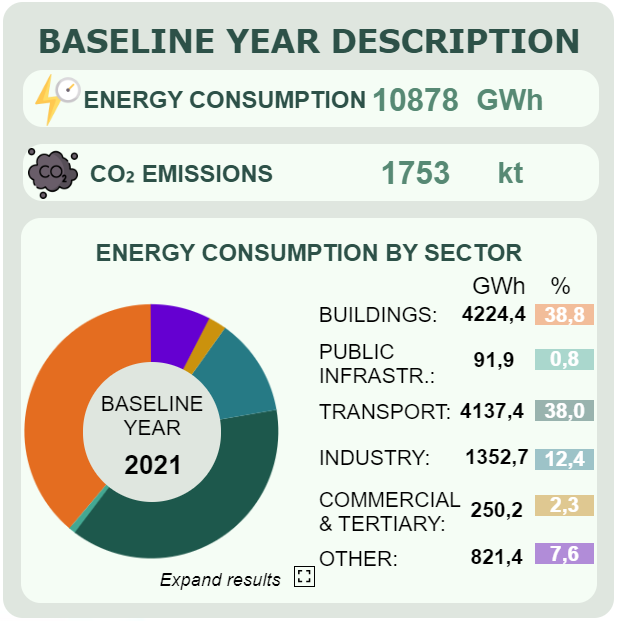
Primary sources of greenhouse gas emissions in Riga include:
- Residential and municipal buildings (38,8 %)
- Transport (38 %)
- Industry (12,4 %)
- Commercial and tertiary sector (2,3 %)
- Public infrastructure (0,8 %)
- Other sectors (7,6 %)
Total Emissions:
Total CO₂ emissions in the baseline year are estimated at approximately 1 752 763 tons CO₂eq.
Total Energy Consumption:
Total energy consumption in the city of Riga is approximately 10 878 GWh per year.
4. Measures and Planning
Focus Areas
The residential and private transport sectors show the highest reduction potential. Riga’s strengths include a comprehensive energy management system and data accessibility. However, limited influence over public transport and industry, as well as challenges in behavioral change, remain barriers. Priority indicators include:
- Renovation rate of residential buildings.
- Passenger kilometers by transport mode.
- Share of LED lighting in public infrastructure.
- Share of electric vehicles in the municipal fleet.
- Waste generated per capita.
CommitClimate supports scenario modeling and cross-sector alignment of emission reduction strategies, strengthening Riga’s ability to reach climate neutrality by 2050.
Key Measures Implemented
Riga is taking a multi-sectoral approach to emissions reduction. Measures include:
- Renovation programs for multi-family residential buildings.
- LED upgrades in public lighting.
- Gradual electrification of the municipal vehicle fleet.
- Promotion of compact urban planning to reduce private transport demand.
The CommitClimate project supports Riga in modeling various decarbonization scenarios, providing clarity on cost-effectiveness and emissions reduction potential of different policy mixes. It also enhances interdepartmental coordination.
Scenario Simulation Results
Residential Buildings:
- Policy: 30% renovation rate of non-renovated multi-family buildings from 2025.
- Results by 2050:
- Annual energy savings: 884 802 MWh (30,6 %)
- Annual CO2 reduction: 70 687 tons (28 %)
Municipality Buildings:
- No additional policies implemented. This decision may reflect limited municipal influence, lack of cost-effective measures, or prioritization of other sectors with higher reduction potential.
Public Infrastructure:
- Policy: LED lighting replacement (5%/year from 2025)
- Results by 2050:
- Energy savings: 12 005 MWh (11,8 %)
- CO2 savings: 876 tons (11,8 %)
Other Sectors:
No additional policy measures proposed. Energy and emission levels remain constant.
Transport Sector:
- Municipal Vehicles (EV fleet transition):
- Energy savings: 3540 MWh (14,1 %)
- CO2 savings: 1073 tons (17,6 %)
- Private Transport Demand Reduction (2%/year travel frequency + distance):
- Energy savings: 2 159 698 MWh (50,7 %)
- CO2 savings: 512 769 tons (52,8 %)
- Public Transport: No policies tested.
Waste Management:
- No policies tested.
Local energy production:
No additional policy measures proposed. Energy and emission levels remain constant.
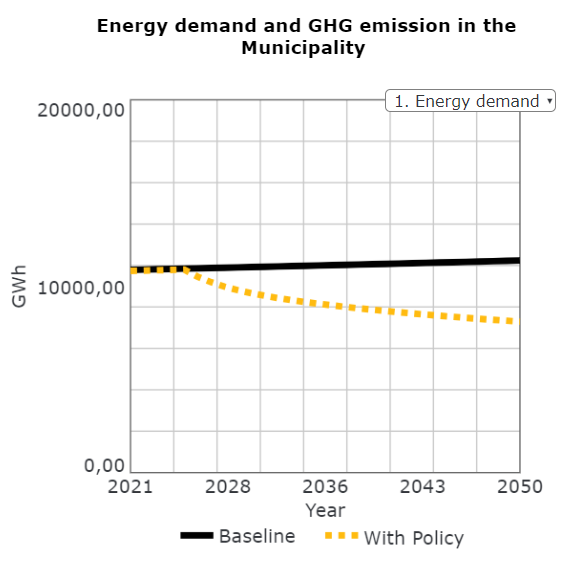
The results of the simulation show that in the baseline scenario energy demand in the municipality increases by approximately 0,15 %/year over time due to population increase and economic and activity growth assumptions. As illustrated in the figure below, total energy demand rises over time, reaching 11 380,43 GWh in the baseline scenario by 2050. The implementation of the selected policy package causes a gradual energy demand decrease, resulting in an energy demand of 8101,29 GWh by 2050. This corresponds to energy savings of 3 279 135,4 MWh, or 28,8 % compared to the baseline projection.
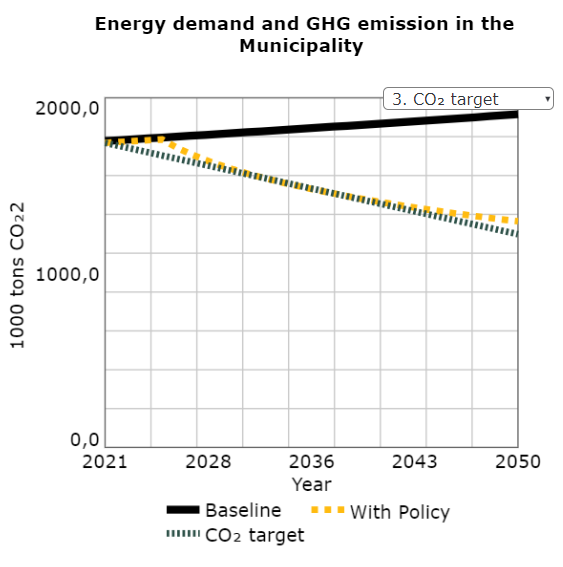
The selected policy package leads to significant emission reductions – CO₂ emissions decrease from 1905,9 thousand tons in the baseline scenario to approximately 1293,7 thousand tons in the policy scenario by 2050, resulting in annual emission savings of 612 204,9 tons (32,1 %). As shown in the figure below, while the policy scenario lowers emissions below the long-term CO₂ target in the time period between 2033 and 2037, the increasing energy demand due to population growth eventually places it above the target trendline indicating that additional mitigation measures would be required to fully achieve the municipality’s climate objectives.
5. First steps implemented
Pre-Feasibility study description
Riga Energy Agency has identified young citizens as one of potential test groups for the Carbon Footprint Calculator and transfer of knowledge gained via testing the simulation tool. An activity “Energy Detective” was developed as an attractive service for the Riga City schools where REA experts provide easy-to-use information about energy consumption data, carbon footprint and steps to be taken by school administration, pupils and their families to reduce the footprint and to use energy in a more efficient way. REA has organized a simple registration tool for the teachers of schools to apply for the “service”. Activity is ongoing until the end of school year – June 2025.
One of the first tasks was to identify Latvian cities that would be interested in using the tool. As the main criteria was raised that cities are in a management phase where their SECAP are developed or renewed. In order to identify the city project team co-operates with the Ministry of Climate and Energy Latvian Association of Local and Regional Governments as well as the Latvian Association of local Governments.
6. Stakeholder Engagement
In October 2024 Riga Municipality together with RTU and REA initiated Riga School Climate Days competition: until April 2025 teams of school kids are engaged in energy saving activities, climate change actions and circular economy promotion in their schools. REA provides information about energy consumption of the particular school and teams are motivated to ensure more efficient usage of water, electricity and heat. Teams are encouraged using Carbon Footprint Calculator developed within the Project. REA provides an expert service to the involved schools – “Energy Detective” that explains basic principles of sustainable energy use. Tools developed and knowledge gained by REA experts within the Project is transferred to young citizens of Riga city. Promotion campaign of the Riga School Climate Days inter alia aims at attracting citizens attention to the sustainable energy use. It is believed that school kids will share the information and suggestions to their families thus multiplying the engagement.
Till 31 December 2024 the REA “Energy Detective” has visited five (5) schools, engaging with approx 180 young citizens and their teachers.
On 13 December 2024 REA organized Riga School Climate Days on-line public discussion with RTU and other experts promoting “Energy Detective” services and inviting citizens to pay attention to the sustainable energy saving initiatives and tools. The recorded discussion is available on Riga City communication channels for all citizens.
Citizen engagement activity is ongoing.Potentially interested cities have been approached to agree on the most appropriate form of action for learning tools. The main step now is to prepare a description of the offer for cities to participate in, as well as a format for organising cooperation. This communication is ongoing.


