1. Municipality Profile – Jokkmokk
Key Economic Sectors
The local economy of Jokkmokk is characterized by a diverse range of activities spanning. The public sector is an important employer. The primary sector collectively provide employment for about 500 individuals. Both Real Estate, Insurance, and Financial Services and Industrial, Energy, and Construction Sectors are key as well as tourism.
Governance Structure
Sweden has three levels of domestic government: national, regional and local level. Jokkmokk is one of 290 municipalities, with own self-governing local authority. Municipalities are legally obliged to provide certain basic services. Jokkmokk is responsible for a broad range of facilities and services including housing, roads, water supply and wastewater processing, schools, public welfare, elderly care, childcare and emergency preparedness. The municipalities are entitled to levy income taxes on individuals, and they also charge for various services. At the regional level, Sweden is divided into 21 regions. Jokkmokk lies in Norrbotten region. The regions are responsible for overseeing tasks such as healthcare and dental care. They are also entitled to levy income taxes to cover their costs. Municipalities have a central role in the development of energy infrastructure. The municipal planning monopoly is a fundamental subset of municipal responsibilities. The municipalities also have an important role in dialogue, the exercise of authority and the strategic development of the local community.
2. Motivation for Climate Neutrality
Reasons for Action
In 2017 Sweden adopted a new climate policy framework. The framework consists of a climate act, climate targets and a climate policy council. Sweden’s long-term target is to achieve zero net greenhouse gas emissions by 2045 at the latest.
Strategic Goals
Long term target
The long-term target for Sweden is zero net greenhouse gas emissions by 2045 and anfer that to achieve negative net emissions. Achieving zero net emissions of greenhouse gases means that the emissions of greenhouse gases from activities in Sweden shall be at least 85 per cent lower in 2045 compared to 1990. The remaining reductions down to zero can be achieved through supplementary measures.
Milestone targets
The milestone targets towards the long-term goal include emissions covered by the EU’s Effort Sharing Regulation (ESR). Emissions covered by the EU Emissions Trading System (EU ETS) are not included. The milestone targets are:
- By 2030 emissions are to be 63 per cent lower than 1990
- By 2040 emissions are to be 75 per cent lower than 1990
International targets and obligations
Sweden as a member state of the European Union is a Party of the Paris Agreement and is obliged to reach binding EU-climate and energy targets.
3. Baseline Assessment
Data Collection Process
Lapplands Kommunalförbund has collected publicly available data to apply the CommitClimate Simulator on the case Jokkmokk mainly from
- Swedish Statistics
- Swedish National Board of Housing, Building and Planning
- Transport Analysis
- Swedish Energy Companies Statistics on District Heating
- Swedish Tax Authority
Further data have been collected through a dialogue with relevant municipal departments and stakeholders in Jokkmokk with support of the Local Working Group and the CommitClimate Survey, mainly to complement data for behaviour-related data of citizens / households.
CO2 Emission Inventory
Sources of Emissions:
Primary sources of greenhouse gas emissions in Jokkmokk municipality include:
- Transport (78.3%)
- Waste management (14.7%)
- Other sectors, including commercial, tertiary, industry, construction, agriculture and forestry (3.2%)
- Residential and municipal buildings (3.9%)
Emissions from public infrastructure are estimated at zero under the electricity emission factors applied in the model.
Total Emissions:
Total greenhouse gas emissions in the baseline year (2023) are estimated at approximately 16,200 tonnes CO₂eq.
Total Energy Consumption:
Total energy consumption in Jokkmokk Municipality in the baseline year is approximately 267.04 GWh/year.
4. Measures and Planning
Focus Areas
These simulations were conducted by Lapplands Kommunalförbund solely for exploratory and analytical purposes. They do not represent official projections, nor have they been adopted or endorsed by Jokkmokk municipality. Rather, these exercises serve as a basis for discussion and reflection among municipal stakeholders and may support future decision-making processes.
The modelling results indicate that commercial, tertiary and other economic sectors offer the largest potential for energy demand reduction, while private transport provides the greatest potential for greenhouse gas emission reductions under the tested policy package.
Energy efficiency improvements in municipal and residential buildings, combined with renewable energy deployment and heating system decarbonisation, also contribute to the transition towards a more sustainable energy system. Public infrastructure improvements and local energy production measures provide additional opportunities to reduce energy demand and operational emissions.
Jokkmokk’s relatively low-carbon electricity supply supports the transition towards electrified heating and transport technologies. However, the modelling results also highlight the importance of measures targeting fossil fuel consumption, particularly in private transport.
Vision of Modeling Results:
The vision is to provide actionable insights into the potential for energy efficiency, renewable energy and sustainable transport in private housing, businesses and transport.
By using the CommitClimate simulator, Lapplands Kommunalförbund aims to identify the most significant opportunities for reducing energy demand and greenhouse gas emissions, thereby supporting more locally tailored energy and climate advisory services.
Opportunities to Implement Measures:
The modeling results will be used to assess potential for action in:
1. Increasing energy efficiency in buildings among households and businesses.
2. Expanding renewable energy generation, tailored to local conditions.
3. Promoting sustainable transport solutions, like electrification of vehicles, cyckling and walking
These opportunities not only reduce emissions but also support local economic growth and improve community well-being.
Barriers:
Despite the potential, several barriers exist, including:
– Limited financial resources or incentives for households and businesses to adopt measures.
– Lack of awareness or technical knowledge about sustainable solutions.
– Challenges in integrating renewable energy into existing systems due to grid limitations or regulatory hurdles.
– Resistance to change due to perceived complexity or cost.
Strengths:
Jokkmokk and our other member municipalities possess key strengths to overcome these barriers, such as:
– A growing awareness of the need to act on energy transition.
– The availability of a free and independent energy and climate advisory service to provide tailored support.
– Access to tools like the CommitClimate simulator, which provides clear, data-driven insights.
Priority Sectors:
Based on the modeling potential, the priority sectors include:
1. Buildings: Enhancing energy efficiency and transitioning to renewable systems like solar.
2. Transport:Promoting electrification as well as cycling/walking for short distances
3. Local Energy Production: Expanding small-scale renewable energy projects to increase self-sufficiency.
Key Performance Indicators (KPIs):
To track progress and ensure impact, we propose the following KPIs:
– Percentage reduction in energy consumption in residential and commercial buildings.
– Increase in the share of renewable energy in total energy consumption.
– Reduction in greenhouse gas emissions from transport.
– Number of households and businesses supported by advisory services and implementing measures.
– Local job creation in renewable energy and sustainable transport sectors.
Key Measures Implemented
Jokkmokk municipality has an adopted local energy plan which is aiming at increasing energy efficiency and the share of renewable energy. The municipality is working together with the three neighboring municipalities Gällivare, Boden and Luleå municipalities in a governmentally financed project to promote joint energy planning. All four municipalities have leading positions in the green industrial transition, attracting investments in mining, steel, hydrogen and fertilizer production, among others. The development of an efficient and sustainable energy system to match the increased energy (mainly electricity) need will therefore be critical.
Lapland’s Municipal Association coordinates municipal energy and climate advisory services for its four member municipalities: Kiruna, Gällivare, Jokkmokk, and Pajala with co-funding of the Swedish Energy Agency. The energy and climate advisory service is free of charge and commercially independent, targeting households, businesses, housing associations, and organizations.
The CommitClimate simulator can play a key role in assessing the potential within these sectors. The simulator provides deeper insights into opportunities for energy efficiency, renewable energy, and sustainable transport in our municipalities. By using this tool, Lapplands Municipal Association and its members can pinpoint the largest opportunities and tailor advice to make the greatest impact. This helps municipalities better understand their communities’ full potential to reduce emissions and transition to sustainable energy systems.

Scenario Simulation Results
These simulations were conducted by Lapplands Kommunalförbund solely for exploratory and analytical purposes. They do not represent official projections, nor have they been adopted or endorsed by Jokkmokk municipality. Rather, these exercises serve as a basis for discussion and reflection among municipal stakeholders and may support future decision-making processes.
Municipal Buildings:
- Policy: Integrated package of building envelope improvements, efficient lighting, appliance optimisation and renewable energy deployment (3–5% annual implementation rates for efficiency measures, starting in 2025).
- Results by 2050:
- Annual energy savings: 364 MWh (1,5 %)
- Annual CO₂ reduction: 260 tons (100 %)
- Annual renewable generation: +2854 MWh
Residential Buildings:
- Policy: Renovation of single- and multi-family houses, electricity-saving measures and renewable and low-carbon technologies (5% annual implementation rates for efficiency measures, starting in 2025).
- Results by 2050:
- Annual energy savings: 3492 MWh (7,7 %)
- Annual CO₂ emissions reduction: 367 tons (100 %)
- Annual renewable generation: +20 697 MWh
Public Infrastructure:
- Policy Measures: Replacement of inefficient public lighting, improvements in clean water preparation and wastewater treatment energy efficiency (0.5–5% annual implementation rates, starting in 2025).
- Results by 2050:
- Energy savings: 409 MWh/year (33 %)
- Annual CO₂ reduction: 0 tonnes, as baseline emissions from electricity consumption in this sector are already zero under the model assumptions.
Other Sectors:
- Policy: Energy efficiency measures in commercial and tertiary activities, industry and construction, agriculture and forestry, and other economic sectors (1% annual implementation rate, starting in 2025).
- Results by 2050:
- Annual energy savings: 28 939 MWh (21,6 %)
- Annual CO₂ emissions reduction: 115 tons (22,2 %)
Transport Sector:
- Municipal Fleet: Electrification of municipal passenger cars, fleet modernisation, driver training and awareness raising, and improved fleet management (0.5% annual implementation rate for efficiency and management measures).
- Results by 2050:
- Annual energy savings: 547 MWh (23,2 %)
- CO₂ reduction: 109 tons (23,9 %)
- Public Transport: Modal shift from private cars to public transport, increasing the public transport mode share by 3 percentage points, from 7% to 10%.
- Results by 2050:
- Annual savings: -87 MWh (-20,3 %)
- CO₂ reduction: -6 tons (-20,3 %)
- The increase reflects additional public transport activity associated with the modal shift. Its impact should be interpreted alongside the corresponding reduction in private transport energy demand and emissions.
- Private Transport: Reduction in passenger travel demand, car sharing, modal shift and transition to low- and zero-emission vehicle technologies, including electricity and hydrogen (0.5–1% annual implementation rates for demand reduction and car sharing, starting in 2025).
- Results by 2050:
- Annual energy savings: 7295 MWh (7,1 %)
- Annual CO₂ reduction: 1770 tons (9 %)
Waste Management:
- No additional policy measures were proposed or tested in the waste management sector. Consequently, the policy scenario remains identical to the baseline scenario, and no additional emission reductions are attributed to waste management policies.
Local energy production:
- Policy: Reduction of district heating losses (5% annual implementation rate, up to a 7% reduction limit), waste heat recovery (25% savings potential) and decarbonisation of district heating, local electricity production and grid electricity supply, starting in 2025.
- Results by 2050:
- Annual energy supply reduction: 8,102 MWh (5.1%)
- Annual CO₂ emissions reduction: 190 tonnes (100%)
Overall Simulation Results
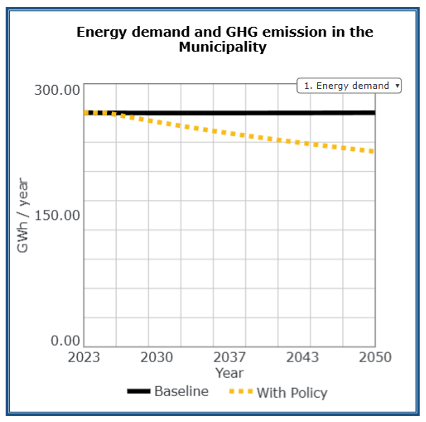
The simulation results show that total municipal energy demand remains relatively stable in the baseline scenario, decreasing slightly from approximately 267.04 GWh/year in 2023 to 266.97 GWh/year by 2050. This development reflects the model’s assumptions concerning population decline and changes in economic and transport activity.
The implementation of the selected policy package leads to a gradual reduction in energy demand, reaching approximately 222.68 GWh/year by 2050.
This corresponds to annual energy savings of approximately 44,285 MWh, or 16.6%, compared with the 2050 baseline projection.
The largest contribution to energy savings comes from commercial, tertiary and other economic sectors, where energy efficiency measures achieve approximately 28,939 MWh/year in savings. Private transport also provides a significant contribution, with approximately 10,580 MWh/year in savings.
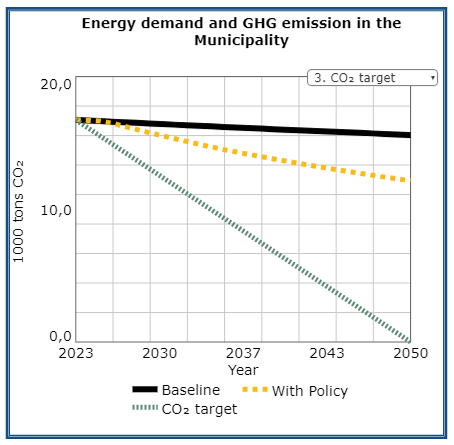
The selected policy package leads to a meaningful reduction in greenhouse gas emissions. Total emissions decrease from approximately 16,200 tonnes CO₂eq in the 2023 baseline year to 15,200 tonnes CO₂eq in the 2050 baseline scenario.
With the selected policy package, annual emissions decline further to approximately 11,900 tonnes CO₂eq by 2050.
This corresponds to annual greenhouse gas emission savings of approximately 3,232 tonnes CO₂eq, or 21.3%, compared with the 2050 baseline projection.
Private transport provides the largest contribution to emission reductions, followed by measures in residential and municipal buildings, other economic sectors and municipal fleet operations.
The results demonstrate that combining energy efficiency improvements, changes in travel behaviour, low-carbon transport technologies and energy supply decarbonisation can substantially reduce energy demand and greenhouse gas emissions.
However, the policy scenario remains above the model’s indicative long-term climate-neutrality trajectory. Additional and more ambitious measures would be required to close the remaining emission-reduction gap, particularly in private transport and waste management.
The simulation results provide exploratory analytical evidence that may support future discussion, policy prioritisation and the preparation or revision of Jokkmokk Municipality’s energy and climate planning framework. They do not constitute officially adopted municipal projections or commitments.
5. First steps implemented
Pre-Feasibility study description
Pre-Feasibility Study: Free Energy Advisory Services for Net-Zero Emissions
Lapplands Kommunalförbund has the officially mandated role in coordinating free municipal energy counselling services for Jokkmokk municipality. Therefore, we used the CommitClimate Simulator to conduct a study to explore the potential of municipal energy counselling to successful energy transition (Title: From Policy to Practice: Exploring Energy Efficiency Potentials and the Role of Municipal Counseling”) We collaborated with the local working group to:
• Explore how enhanced municipal energy counselling could contribute to long-term energy transition goals.
• Illustrate local benefits that could arise from scaling up this service, including reductions in energy demand and greenhouse gas emissions.• Identify enabling conditions and required resources to maximize impact.
This study applies the Simulator to Jokkmokk, Sweden, to explore how free municipal energy counseling can accelerate the transition to renewable energy, enhance energy efficiency, and promote sustainable transport solutions. Three scenarios are analyzed: (1) Electrification, focusing on household PV adoption and electric vehicle uptake; (2) Resilience, emphasizing decentralized energy solutions, storage, and behavioral transport shifts; and (3) Commercial Efficiency, targeting energy savings and low-carbon transport in businesses.
Findings indicate that energy counseling can significantly increase renewable energy adoption, improve energy efficiency beyond baseline scenario, and accelerate the shift to sustainable transport, leading to major economic benefits. In the residential sector, additional PV installations could generate 10.8 GWh of renewable electricity and 28.2 million SEK in local economic benefits over 30 years. Behavior-based energy efficiency measures could save up to 7.5 million kWh annually, reducing household and business costs. In transport, accelerating the adoption of electric vehicles, cycling, and car-sharing by 10 years could yield 1.48 billion SEK in fuel cost savings.
6. Stakeholder Engagement
Lapplands Kommunalförbund has played a central role in facilitating community engagement throughout the project. Acting on behalf of its member municipalities, the organisation coordinates municipal energy counselling services, which has established a broad and effective network of relevant stakeholders, including local businesses, small and medium-sized enterprises (SMEs), and citizens. This structure ensures continuous communication and dialogue channels within the community.
As part of the project, Lapplands Kommunalförbund formed a local working group comprising representatives from its member municipalities. This group has provided strategic input and facilitated local coordination efforts.
To enhance the data quality for the CommitClimate Simulator, a comprehensive citizen survey was conducted, focusing on energy use, transport patterns, consumption habits, and waste management within households.
In addition to the survey, a series of interactive workshops for citizens have been organised. These began with an engaging climate-themed event to spark public interest, followed by hands-on workshops where participants were given the opportunity to explore and test the CommitClimate Simulator directly. These activities have strengthened citizen participation, increased awareness, and provided valuable feedback for further development of the tool.