
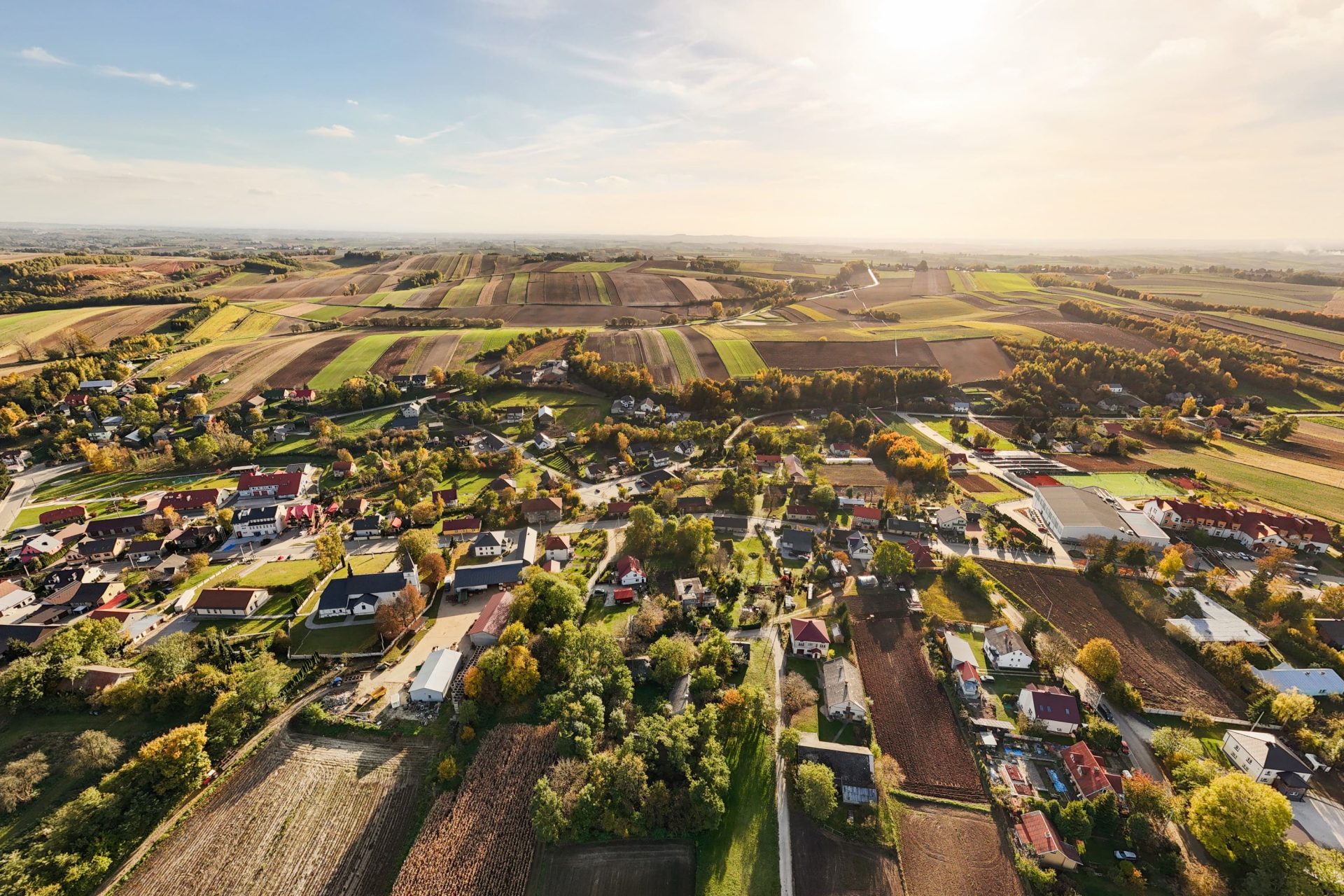
1. Municipality Profile
Key Economic Sectors
Pałecznica municipality is agricultural commune, characterized by very good soils and clean air. The natural wealth of the commune is unpolluted brown, black and alluvial soils. They have been classified in the highest quality class due to their productive nature. They cover around 80% of the municipality area.
Governance Structure
The concept is grounded in the principle of decentralization, giving local authorities autonomy to manage certain public affairs, finance, and policies without direct intervention from the central government.
Gmina (municipality) is the smallest administrative unit, responsible for local services such as education, public safety, and infrastructure. It can consist of urban areas (cities) or rural areas (villages). There are over 2,400 municipalities in Poland.
Local government representatives are directly elected by citizens in general elections. These include:
- Mayor: The head of a municipality, responsible for overseeing and running the commune.
- Councilors: Elected to represent the citizens at the municipality. Their role includes adopting budgets, approving policies, and making decisions about local development.
2. Motivation for Climate Neutrality
Reasons for Action
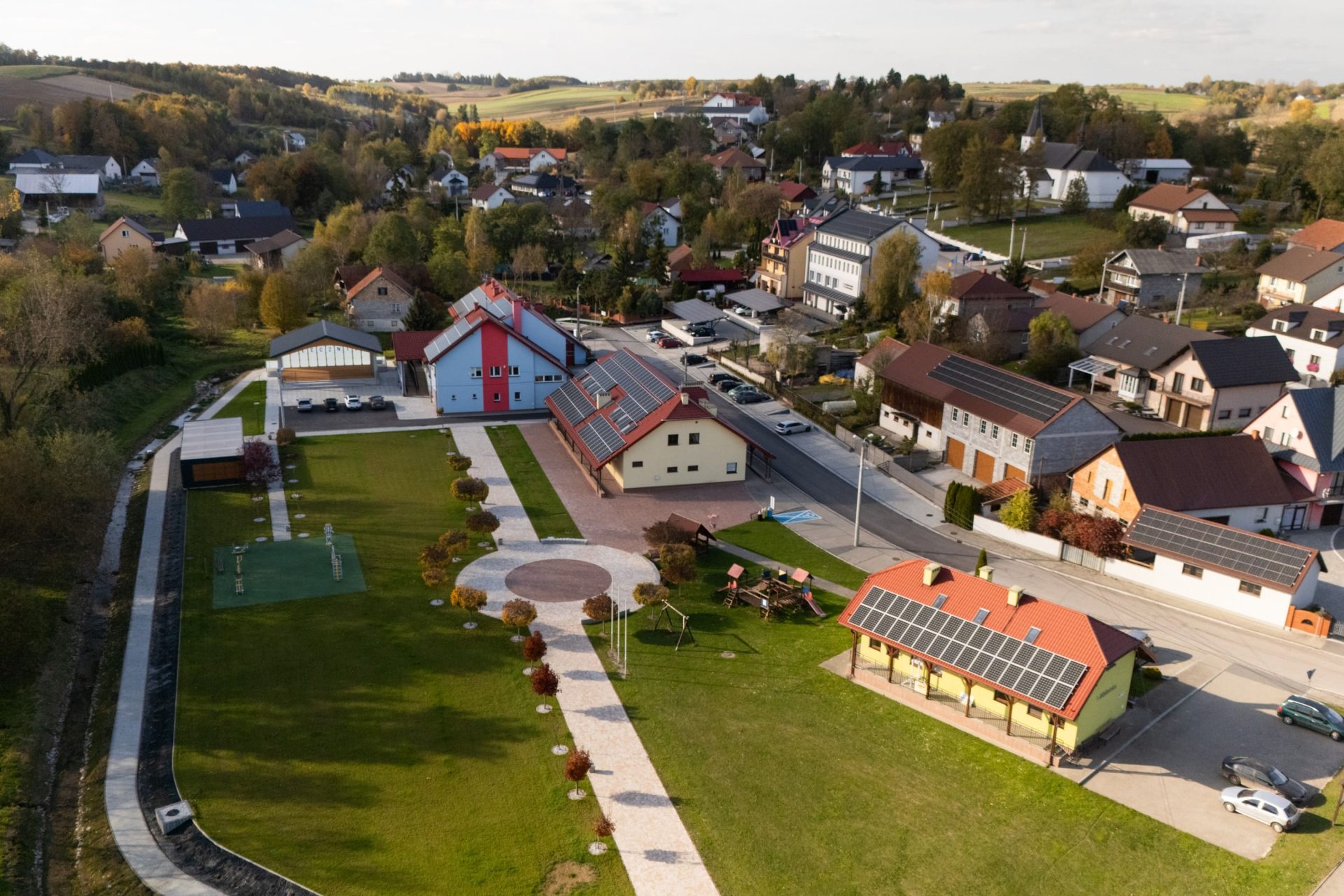
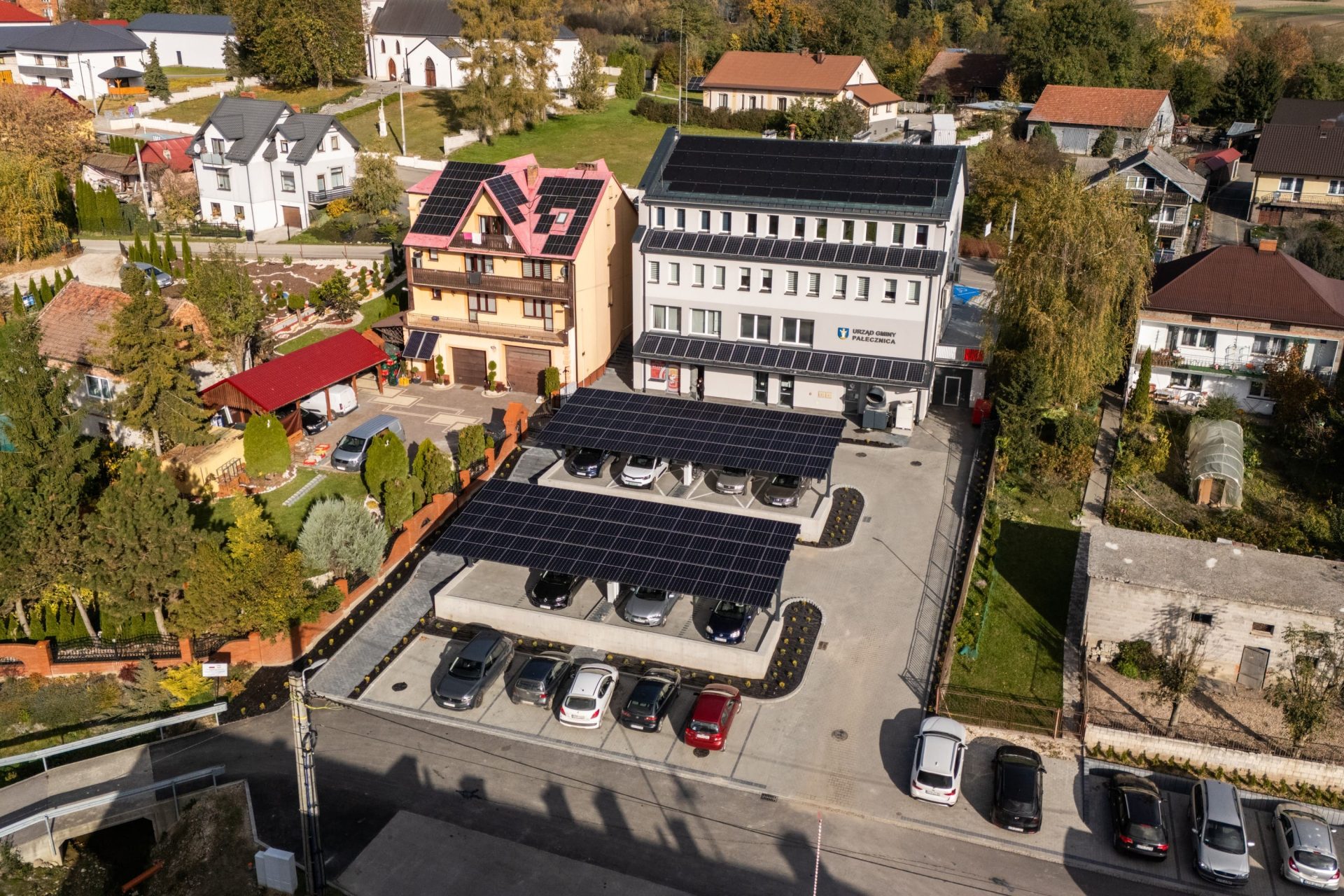
Pałecznica is very active in fields of energy efficiency, renewable energy and water treatment. Among finalized project there can be found PV installations for public and private buildings, buildings thermal modernization, heat pumps, water treatment and ICT implementations. It all began in 2013, when first heat pumps for public buildings were installed. They were supported with PV installations in 2015 and this was a trigger for further development. It showed that change from fossil fuels can give economic, ecologic and health benefits. Since then almost all public buildings has been equipped in PV installations and replaced heating systems. Moreover some projects with financial support for private households in renewable energy sources were implemented.
Strategic Goals
The strategic goal for public buildings and infrastructure (including transport) is to become energy-independent from external suppliers. This requires further development of renewable energy sources like PV and more stable sources (e.g., biomass).
3. Baseline Assessment
Data Collection Process
Municipality has several sources of data required for CO2 inventory:
- Baseline inventory for local low-carbon economy plan – data gathered for year 2014,
- CommitClimate survey,
- Data gathered by an Intelligent Energy Management Centre – local system for energy management and data collection working since 2022,
- Data from Statistics Poland – national database,
- Data from County Communication Office – with data about type and number of vehicles registered in the municipality
- Data from the General Directorate for National Roads and Motorways – with data about traffic intensity.
- Building Emissions Central Register (started in July 2021).
Most difficult data to collect is data from transport in private sector – this data is an expert estimates based on surveys and data from national documents. Secondly data about local energy production by private installations – only from owners (surveys).
CO2 Emission Inventory
Sources of Emissions:
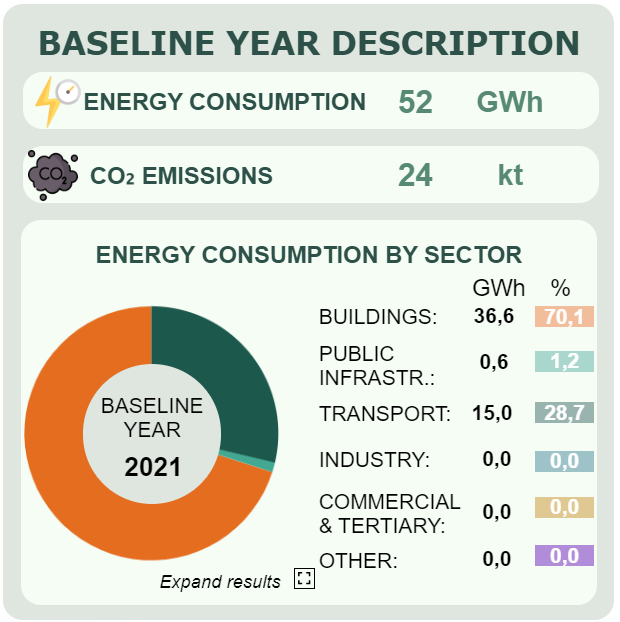
Primary sources of greenhouse gas emissions in Pałecznica municipality include:
- Residential and municipal buildings (70,1 %)
- Transport (28,7 %)
- Public infrastructure (1,2 %)
Total Emissions:
Total CO₂ emissions in the baseline year are estimated at approximately 24 146 tons CO₂eq.
Total Energy Consumption:
Total energy consumption in Cēsis municipality is approximately 52,2 GWh per year.
Other Environmental Data
The municipality also tracks energy consumption across sectors and is integrating renewable energy data through local monitoring. Waste volumes, wastewater treatment electricity use, and water supply energy needs are tracked under the Public Infrastructure sector. Environmental performance of public services is monitored, but air quality or biodiversity data is not yet integrated into the inventory.
4. Measures and Planning
Focus Areas
Modeling results underscore that residential buildings are the most critical sector for Palecznica, contributing the majority of emissions and energy use. Targeted renovations offer a strong return on investment in terms of emissions reduction. Similarly, waste management presents a relatively small but impactful opportunity for GHG reductions. Transport electrification, though limited in scale, shows high decarbonization potential for the municipal fleet.
Key strengths include:
- Active development of RES since 2015
- Strong foundation for public building upgrades
- Community waste engagement infrastructure
Barriers include limited municipal control over private transport and public transport systems, and difficulties in acquiring granular private-sector data.
Conclusion: Palecznica’s most effective decarbonization strategy focuses on building renovation (especially in residential buildings), waste management optimization, and the continued electrification of municipal transport. Supported by the CommitClimate project tools and European best practices, the municipality is well-positioned to take informed, data-driven steps toward climate neutrality.
Key Measures Implemented
Transport: purchase of electric vehicles (municipal fleet, school coaches).
Public lightning: Dec 24 an agreement for replacement of all public (sodium) lamps into LED was signed. Measures will take place in 2025-2026.
Waste management: municipal waste selective collection point for citizens was opened in 2021 – inhabitants can deposit recyclable waste, old but functional goods (for second hand users), repair items. Another such point is foreseen – project is ready, actually searching for financing.
Buildings: step-by-step renovation of public buildings, with emphasis on zero-energy requirements. Dec 24 – proposal for thermal modernizations of schools and kindergarten was submitted (estimated costs of work around 2 mln €).
RES: PV installations development since 2015 (849 kWp in total), 11 major buildings using heat pumps (11 – 161 kW), biogas/biomass or wind energy in plans
CommitClimate: 1. gives a broader perspective on energy management thanks to exchange of experience with European partners. 2. support with tools for simulations of most important measures.
Scenario Simulation Results
Municipal Buildings:
- Policy: One time replacement of inefficient light bulbs, ventilation optimization and renewable energy deployment.
- Results by 2050:
- Annual energy savings: -635 MWh (-26 %)
- Annual CO₂ reduction: 59 tons (3,8 %)
- Annual renewable generation: +1 MWh
Residential Buildings:
- Policy: Renovation of single-family houses from 2025 (3 %/year).
- Results by 2050:
- Annual energy savings: 1524 MWh (4,4 %)
- Annual CO₂ emissions reduction: 729 tons (4,3 %)
Public Infrastructure:
- No public infrastructure policies were tested. This decision may reflect limited municipal influence, lack of cost-effective measures, or prioritization of other sectors with higher reduction potential.
Other Sectors:
- Not included in the simulation model for Pałecznica; no policies analyzed.
Transport Sector:
- Municipal Fleet: Vehicle fleet electrification.
- Results by 2050:
- Annual energy savings: 549 MWh (12,1 %)
- CO₂ reduction: 62 tons (6 %)
- Public Transport: No public transport policies were tested. This decision may reflect limited municipal influence, lack of cost-effective measures, or prioritization of other sectors with higher reduction potential.
- Private Transport: No public transport policies were tested. This decision may reflect limited municipal influence, lack of cost-effective measures, or prioritization of other sectors with higher reduction potential.
Waste Management:
- Policy: Per capita waste generation reduction (0,5 %/year), waste disposal reduction (Disposal -14 %, Recycling +14 %).
- Results by 2050:
- Waste generation reduction: 128,6 tons (11,8 %)
- GHG reduction: 209 tons (12,4 %)
Local energy production:
- Not included in the simulation model for Pałecznica; no policies analyzed.
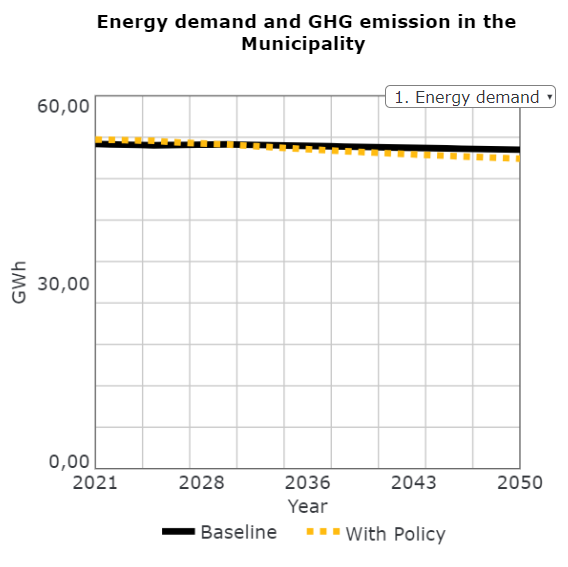
The results of the simulation show that in the baseline scenario energy demand in the municipality decreases from 52,24 GWh in the baseline year to 51,32 GWh in 2050 due to a dwindling population. As illustrated in the figure below, the implementation of the selected policy package causes a gradual energy demand decrease, resulting in an energy demand of 49,89 GWh by 2050. This corresponds to energy savings of approximately 1437,1 MWh, or 2,8 % compared to the baseline projection.
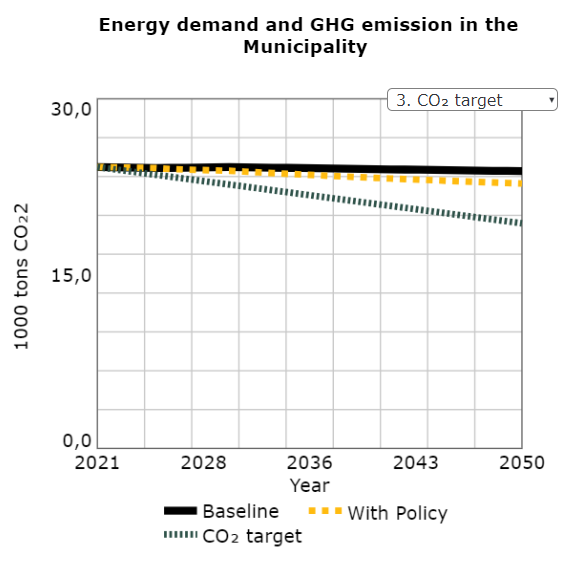
The selected policy package leads to similarly modest emission reductions – CO₂ emissions decrease from 23,8 thousand tons in the baseline scenario to approximately 22,7 thousand tons in the policy scenario by 2050, resulting in annual emission savings of 1060,4 tons (4,5 %). As shown in the figure below, while the policy scenario slightly lowers emissions compared to the baseline trajectory, emissions remain above the long-term CO₂ target, indicating that additional mitigation measures would be required to fully achieve the municipality’s climate objectives.
5. First steps implemented
Pre-Feasibility study description
In the case of Pałecznica, it was noticed that school buildings are the ones that require the most attention in terms of energy efficiency. Thermal insulation of school buildings is usually performed by all municipalities, as the most effective method of decreasing heat losses. In our case, we decided to check what happens when a natural (gravity) ventilation system is replaced by mechanical ventilation. Estimated heat losses due to ventilation are around 30-55%, so there is a huge saving potential. Additionally, mechanical ventilation can provide air quality and temperature measurements, which can be used to improve users’ comfort. In this case school building was built in 2011, so some construction work will be necessary to foreseen.
All schools built in the Baltic Sea Region in the period 1960-2010 have the same problem with gravity ventilation: in winter time causes buildings to cool down. During the construction time investors use less expensive solution – gravity ventilation. At the time of building use, it turns out that this solution has major defect: energy loses and no control options. Feasibility study will help to check the possibility of implementing mechanical ventilation in an existing building. Such investment may become a good practice for other municipalities/schools.